OMNI Office Medicine(tm) for Windows XP
DAILY REPORT MENU
OVERVIEW: The Daily Report Menu program allows you to print
out a daily journal showing all the transactions,
corrections, patient charges and credits that
occurred on a specific date or during a specific
time period.
PROCEDURE: From the Main Menu select Option 3, Daily Report
Menu, and press <Enter>.
EXAMPLE MENU:
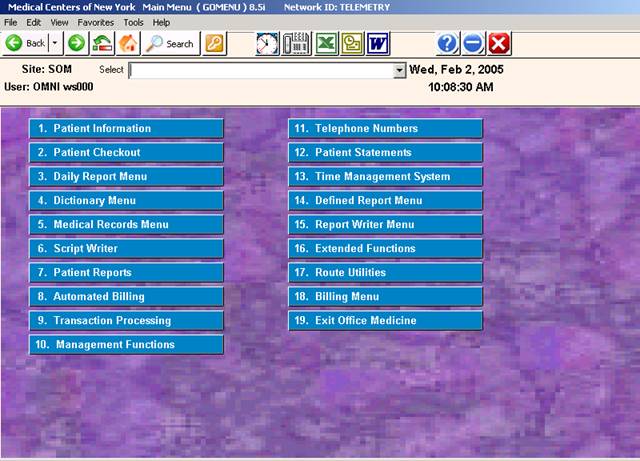
After you select No. 3 from the Main Menu, the following
Daily Report Menu will be displayed.
EXAMPLE MENU:
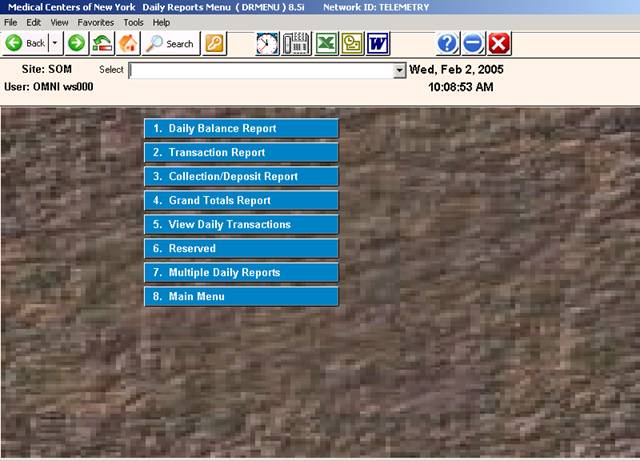
The following pages contain documentation for each of
the above listed programs.
DAILY BALANCE REPORT
OVERVIEW: This is the report to run to store totals for
the Monthly Financial Report.
This report must be generated daily to calculate
totals for your month end reports.
PROCEDURE: From the Daily Report Menu, select Option 1,
Daily Balance Report and press <Enter>.
After selecting Number 1, the system will open a window in
middle of your screen listing the available output devices.
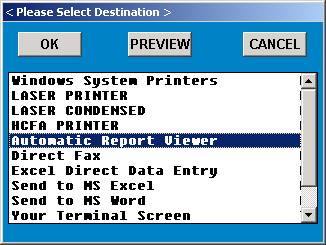
Select the appropriate output device and press <Enter>. The
system will then ask you to enter sites for processing.
EXAMPLE SCREEN:
<*> for All= Multiple sites running in the daily log
will now perform multiple close(s) and multiple
combined totals for all sites selected.
NOTE:
If your practice does not have more than one location, the
system will not ask you to list the sites for processing.
The screen on the next page will be displayed.
EXAMPLE SCREEN:
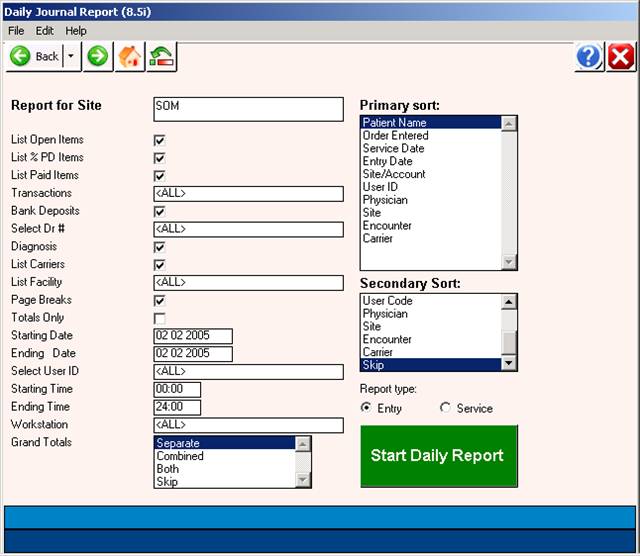
ENTER PARAMETER: The cursor will be flashing at the ENTER
PARAMETER 1-17 prompt. You have eighteen options to choose
from that will appear on your Daily Balance Report. You may
list all items that are unpaid; items that have been partially
paid; items that have been paid; all transactions for a given
period of time; and the amount of money generated by a certain
facility and/or insurance carrier.
TO CHANGE DEFAULTS: If you need to change any of the defaults,
simply enter the line number at the flashing cursor and press
<Enter>. A Y (yes) will change to an N (no) except for Line #6
which requires that all physicians print or you need to enter a
specific physician. Line #14 has an N default, but you may enter
a specific operator's ID if you wish. Line #17 has a default of
ALL, but you may enter a specific terminal.
Once the appropriate parameters have been entered at the ENTER
PARAMETER 1-17 prompt, press <Enter>.
1. LIST OPEN ITEMS: This option will list the claims which
still have a balance remaining. This
billing log can be printed at a later
date, listing only open items.
2. LIST PART ITEMS: This option will provide you with a
listing of claims which have had a
PARTIAL INSURANCE PAYMENT: e.g. Medicare
has made payment and no payment received
from the supplemental carrier.
3. LIST PAID ITEMS: This option will list the claims that
have been paid: e.g. office visits that
were paid by the patient because the
service was not covered by the insurer.
4. TRANSACTIONS: ALL= A printout of all payments, adjustments,
corrections and transfers on all accounts.
If you want this printout for specific trans-
actions, type 4 at the Action Line and press
<Enter>. Your cursor will move to that
field. Now type in the specific transaction
codes.
5. BANK DEPOSITS: This option will list the bank deposit
totals or collection report totals for
each physician and for the clinic as a
whole.
6. SELECT DR # : The Daily Balance Report is normally
printed for all physicians in the
practice. If you desire to print a
report for a specific physician, type in
the provider code number in Field 6 and
press <Enter>.
PROVIDER BREAKOUT PROMPT:
When selecting multiple providers, the system will
prompt for Separate or Combined reports.
This option works with single or multiple sites.
NOTE: If you print the Daily Balance Report for
selected physicians, you must print the
report for the entire practice last in order
to save totals for MTD/YTD.
7. DIAGNOSIS: If you desire to have a specific
diagnosis appear on the report, keep
the default Y in Field 7. This
information is obtained from Patient
Checkout
8. LIST CARRIERS: Listing carriers will print the
patient's primary insurance carrier on
the report: e.g. BS, MR, MD, and all
private insurances.
9. LIST FACILITY: Listing the facility will print the
facility abbreviation on each claim
service line that was performed outside
of the office.
10. PAGE BREAKS: The Daily Balance Report may be printed
with each heading starting on a new page.
11. TOTALS ONLY: If you desire to have totals only. This
field should be changed to Y. The default
is No.
12. STARTING D/O/E: The starting and ending D/O/E defaults
13. ENDING D/O/E: to the current system date. This report
should be printed on a daily basis. If
you do not print this report at the end
of the day, it can be printed the
following day. You must change the
starting and ending D/O/E to the date
required.
14. SELECT OP ID: This allows you to balance out a selected
operator at the end of his/her shift. An N
in this field will print all input activity
for the date you specified. To change the
default of No, type 14 and press <Enter>.
The following prompt will be displayed:
SELECT BY OPERATOR OR COMPANY (O/C)?
O=Will ask you to enter Operator ID.
C=Will ask you to enter Company ID.
(The company code you enter here is
found in field #4 of the Operator ID
dictionary.)
15. STARTING TIME The default starting time will be 0000
16. ENDING TIME: and the ending default time will be
2400. Hours are calculated in military
time. Normally, there is no reason to
change the default times, unless you are
trying to balance a specified operator
for a certain time period.
17. WORKSTATION ID: The default for Workstation ID is to print
for all terminals. Again, in most
situations there is no need to change
this default, unless you are trying to
balance out a specific terminal. The
terminal ID's are identified as T0, T1,
T2, T3, etc.
SORT PARAMETERS: The sort parameters menu will appear on the
right hand side of your screen. Choose the order in which you
would like the Daily Balance Report to print and press <Enter>.
DEFINITION OF SORT PARAMETERS:
1. PATIENT NAME: This option of sorting entered claims will
print the patients in alphabetical order.
The date of service and date of entry are
ignored when this type of sort is performed.
2. ORDER ENTERED: This option of sorting claims will print
the claims in the exact order in which
they were entered into the system.
3. D/O/S - NAME: This option will sort patients alphabetically
for each date of service requested.
4. D/O/E - NAME: This will sort patients alphabetically for
each date of entry requested (if a log is
printed for more than one date of entry).
5. D/O/E-ACCOUNT#: Patients will be printed by their account
number by each date of entry.
6. ENCOUNTER NUMBER: Patients will be printed by their Encounter
Number.
EXPLANATION OF REPORTS
ENCOUNTER SCHEDULE: The first page of the Daily Balance Report
is called the Encounter Schedule. The total for each encounter
now prints on the charges report on a per patient basis. The
Encounter Schedule will list all patients with claim line items
entered on the specified date of entry. This part of the log will
print all no check-out entries. These are patient's that had a
route slip printed for them, but no claim was entered.
The report will contain these headings: Patient Name and Account
Number, Date of Entry and Date of Service, User ID, Dr. #,
Procedure Code and Description, Diagnosis Code, Insurance Type,
Facility, Assignment, Patient Amount, Insurance Amount, and
Original Charge.
ENCOUNTER SUMMARY: The Encounter Summary portion of the Daily
Balance Report will summarize the totals from the Encounter
Schedule.
TRANSACTION REPORT: The Transaction Report portion of the Daily
Balance Report lists all of the items recorded in Patient Check-
out, Define Transactions, and Line Item.
The report headings are: Patient Name, Account Number, Date of
Entry, Date of Service, User ID, Dr. #, Procedure Code,
Description, Patient Amount, and Insurance Amount.
TRANSACTION SUMMARY: The summary transaction totals for each
physician(s) on the specified date of entry.
COLLECTION REPORT: The Collection Report will list accounts
which had payments posted. These payments will be listed in
three columns: Patient Cash, Patient Checks, and Insurance Checks.
The column in which a payment appears is determined by the
Transaction Definition Dictionary.
COLLECTION TOTALS REPORT: The Collections Totals Report will
give you a total of the various types of payments received
per physician and a total for the entire practice.
TRANSACTION REPORT
OVERVIEW: The Transaction Report program will allow you
to print a report listing all entries from
Patient Checkout, Define Transactions, and Line
Item.
PROCEDURE: From the Daily Report Menu select Option 2,
Transaction Report, and press <Enter>.
After selecting Number 2, the system will open a window in
middle of your screen listing the available output devices.
Select the appropriate output device and press <Enter>. The
system will then ask you to enter sites for processing.
EXAMPLE SCREEN:
NOTE:
If your practice does not have more than one location, the
system will not ask you to list the sites for processing.
The screen on the next page will be displayed.
EXAMPLE SCREEN:
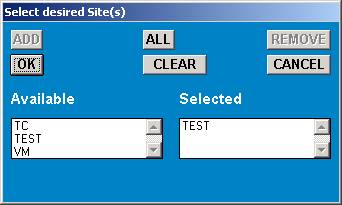
ENTER PARAMETER: The cursor will be flashing at the ENTER
PARAMETER 1-10 prompt. You have ten options to choose
from that will appear on your Transaction Report.
TO CHANGE DEFAULTS: If you need to change any of the defaults,
simply enter the line number at the flashing cursor and press
<Enter>. A Y (yes) will change to an N (no) except for Line #2
which requires that all physicians print or you need to enter a
specific physician. Line #7 has an N default, but you may enter
a specific operator's ID if you wish. Line #10 has a default of
ALL, but you may enter a specific terminal.
Once the appropriate parameters have been entered at the ENTER
PARAMETER 1-10 prompt, press <Enter>.
1. TRANSACTIONS: Listing transactions will provide you
with a printout of all payments,
adjustments, corrections and transfers
on each account.
2. SELECT DR # : The Transaction Report is normally printed
for all physicians in the practice. If you
desire to print a report for a specific
physician, type in the provider code number
in Field 2 and press <Enter>.
NOTE: If you print the Transaction Report for
selected physicians, you must print the
report for the entire practice last.
3. PAGE BREAKS: The Transaction Report may be printed
with each heading starting on a new page.
4. TOTALS ONLY: If you desire to have totals only. This
field should be changed to Y. The default
is No.
5. STARTING D/O/E: The starting and ending D/O/E defaults
6. ENDING D/O/E: to the current system date. This report
should be printed on a daily basis. If
you do not print this report at the end
of the day, it can be printed the
following day. You must change the
starting and ending D/O/E to the date
required.
7. SELECT OP ID: A no response in Select OP ID will print
all input activity for the date you have
specified. If you wish to balance out a
selected operator at the end of her shift,
select No. 7 and press <Enter>. This
will move the cursor to the SELECT OP ID
prompt. Enter the initials (ID) of the
selected operator.
8. STARTING TIME The default starting time will be 0000
9. ENDING TIME: and the ending default time will be
2400. Hours are calculated in military
time. Normally, there is no reason to
change the default times, unless you are
trying to balance a specified operator
for a certain time period.
10. Workstation ID: The default for Workstation ID is to print
for ALL workstations. Again, in most
situations there is no need to change
this default, unless you are trying to
balance for a specific workstation. The
workstation ID's are identified as T00, T01,
T02, T03, etc.
SORT PARAMETERS: The sort parameters menu will appear on the right
hand side of your screen. Choose the order in which you would like
the Transaction Report to print and press <Enter>.
1. PATIENT NAME: This option of sorting entered claims will
print the patients in alphabetical order.
The date of service and date of entry are
ignored when this type of sort is performed.
2. ORDER ENTERED: This option of sorting claims will print
the claims in the exact order in which
they were entered into the system.
3. D/O/S - NAME: This option will sort patients alphabetically
for each date of service requested.
4. D/O/E - NAME: This will sort patients alphabetically for
each date of entry requested (if a log is
printed for more than one date of entry).
5. D/O/E-ACCOUNT#: Patients will be printed by their account
number by each date of entry.
6. ENCOUNTER NUMBER: Patients will be printed by their Encounter
Number.
DEPOSIT REPORT
OVERVIEW: The Deposit Report program will allow you to run
a report that indicates all deposits (including
capitation payments) made to the clinic's account
by all, some, or one operator.
PROCEDURE: From the Daily Report Menu, select Option 3,
Deposit Report, and press <Enter>.
After selecting Number 3, the system will open a window in
middle of your screen listing the available output devices.
Select the appropriate output device and press <Enter>. The
system will then ask you to enter sites for processing.
EXAMPLE SCREEN:
NOTE:
If your practice does not have more than one location, the
system will not ask you to list the sites for processing.
The screen on the next page will be displayed.
ENTER PARAMETER: The cursor will be flashing at the ENTER
PARAMETER 1-10 prompt. You have ten options to choose
from that will appear on your Deposit Report.
TO CHANGE DEFAULTS: If you need to change any of the defaults,
simply enter the line number at the flashing cursor and press
<Enter>. A Y (yes) will change to an N (no) except for Line #2
which requires that all physicians print or you need to enter a
specific physician. Line #7 has an N default, but you may enter
a specific operator's ID if you wish. Line #10 has a default of
ALL, but you may enter a specific terminal.
Once the appropriate parameters have been entered at the ENTER
PARAMETER 1-10 prompt, press <Enter>.
1. BANK DEPOSITS: This option will list the bank deposit
totals or collection report totals for
each physician and for the clinic as a
whole.
2. SELECT DR # : The Deposit Report is normally printed for
all physicians in the practice. If you
desire to print a report for a specific
physician, type in the provider code number
in Field 2 and press <Enter>.
NOTE: If you print the Deposit Report for selected
physicians, you must print the report for
the entire practice last.
3. PAGE BREAKS: The Deposit Report may be printed with each
heading starting on a new page.
4. TOTALS ONLY: If you desire to have totals only. This
field should be changed to Y. The default
is No.
5. STARTING D/O/E: The starting and ending D/O/E defaults
6. ENDING D/O/E: to the current system date. This report
should be printed on a daily basis. If
you do not print this report at the end
of the day, it can be printed the following
day. You must change the starting and ending
D/O/E to the date required.
7. SELECT OP ID: This allows you to balance out a selected
operator at the end of his/her shift. An N
in this field will print all input activity
for the date you specified. To change the
default of No, type 14 and press <Enter>.
The following prompt will be displayed:
SELECT BY OPERATOR OR COMPANY (O/C)?
O=Will ask you to enter Operator ID.
C=Will ask you to enter Company ID.
(The company code you enter here is
found in field #4 of the Operator ID
dictionary.)
8. STARTING TIME The default starting time will be 0000 and
9. ENDING TIME: the ending default time will be 2400. Hours
are calculated in military time. Normally,
there is no reason to change the default times,
unless you are trying to balance a specified
operator for a certain time period.
10. TERMINAL ID: The default for Terminal ID is to print
for ALL terminals. Again, in most
situations there is no need to change
this default, unless you are trying to
balance out a specific terminal. The
terminal ID's are identified as T0, T1,
T2, T3, etc.
SORT PARAMETERS: The sort parameters menu will appear on the right
hand side of your screen. Choose the order in which you would like
the report to print and press <Enter>.
DEFINITION OF SORT PARAMETERS:
1. PATIENT NAME: This option of sorting entered claims will
print the patients in alphabetical order.
The date of service and date of entry are
ignored when this type of sort is performed.
2. ORDER ENTERED: This option of sorting claims will print
the claims in the exact order in which
they were entered into the system.
3. D/O/S - NAME: This option will sort patients alphabetically
for each date of service requested.
4. D/O/E - NAME: This will sort patients alphabetically for
each date of entry requested (if a log is
printed for more than one date of entry).
5. D/O/E-ACCOUNT#: Patients will be printed by their account
number by each date of entry.
6. ENCOUNTER NUMBER: Patients will be printed by their Encounter
Number.
OMNI Office Medicine(tm) for Windows XP
DAILY FINANCIAL REPORT
(FDR #) v8.4
GRAND TOTALS REPORT
OVERVIEW: The Grand Totals Report program allows you to
print a daily journal showing all charges,
payments, etc. for a specified time frame.
It looks very similar to a Monthly Financial
Report.
PROCEDURE: From the Daily Report Menu, select Option 4,
Grand Totals Report, and press <Enter>.
After selecting Number 4, the system will open a window in
middle of your screen listing the available output devices.
EXAMPLE SCREEN:
1. Okidata 393 (LP) <O
2. Okidata 320 (P1)
3. HP Laser III (P2)
4. Your Terminal Screen (TE)
5. ---> EXIT <---
Select the appropriate output device and press <Enter>. The
system will then ask you to enter sites for processing.
EXAMPLE SCREEN:
NOTE:
If your practice does not have more than one location, the
system will not ask you to list the sites for processing.
The screen on the next page will be displayed.
ENTER PARAMETER: The cursor will be flashing at the ENTER
PARAMETER 1-17 prompt. You have seventeen options to choose
from that will appear on your Grand Totals Report. You may
list all items that are unpaid; items that have been partially
paid; items that have been paid; all transactions for a given
period of time; and the amount of money generated by a certain
facility and/or insurance carrier.
TO CHANGE DEFAULTS: If you need to change any of the defaults,
simply enter the line number at the flashing cursor and press
<Enter>. A Y (yes) will change to an N (no) except for Line #6
which requires that all physicians print or you need to enter a
specific physician. Line #14 has an N default, but you may enter
a specific operator's ID if you wish. Line #17 has a default of
ALL, but you may enter a specific terminal.
Once the appropriate parameters have been entered at the ENTER
PARAMETER 1-17 prompt, press <Enter>.
1. LIST OPEN ITEMS: This option will list the claims which
still have a balance remaining. This
billing log can be printed at a later
date, listing only open items.
2. LIST PART ITEMS: This option will provide you with a
listing of claims which have had a
PARTIAL INSURANCE PAYMENT: e.g. Medicare
has made payment and no payment received
from the supplemental carrier.
3. LIST PAID ITEMS: This option will list the claims that
have been paid: e.g. office visits that
were paid by the patient because the
service was not covered by the insurer.
4. TRANSACTIONS: ALL= A printout of all payments, adjustments,
corrections and transfers on all accounts.
If you want this printout for specific trans-
actions, type 4 at the Action Line and press
<Enter>. Your cursor will move to that
field. Now type in the specific transaction
codes.
5. BANK DEPOSITS: This option will list the bank deposit
totals or collection report totals for
each physician and for the clinic as a
whole.
6. SELECT DR # : The Grand Totals Report is normally
printed for all physicians in the
practice. If you desire to print a
report for a specific physician, type in
the provider code number in Field 6 and
press <Enter>.
NOTE: If you print the Grand Totals Report for
selected physicians, you must print the
report for the entire practice last.
7. DIAGNOSIS: If you desire to have a specific
diagnosis appear on the report, keep
the default Y in Field 7. This
information is obtained from Patient
Checkout
8. LIST CARRIERS: Listing carriers will print the
patient's primary insurance carrier on
the report: e.g. BS, MR, MD, and all
private insurances.
9. LIST FACILITY: Listing the facility will print the
facility abbreviation on each claim
service line that was performed outside
of the office.
10. PAGE BREAKS: The Grand Totals Report may be printed
with each heading starting on a new page.
11. TOTALS ONLY: If you desire to have totals only. This
field should be changed to Y. The default
is No.
12. STARTING D/O/E: The starting and ending D/O/E defaults
13. ENDING D/O/E: to the current system date. This report
should be printed on a daily basis. If
you do not print this report at the end
of the day, it can be printed the
following day. You must change the
starting and ending D/O/E to the date
required.
14. SELECT OP ID: This allows you to balance out a selected
operator at the end of his/her shift. An N
in this field will print all input activity
for the date you specified. To change the
default of No, type 14 and press <Enter>.
The following prompt will be displayed:
SELECT BY OPERATOR OR COMPANY (O/C)?
O=Will ask you to enter Operator ID.
C=Will ask you to enter Company ID.
(The company code you enter here is
found in field #4 of the Operator ID
dictionary.)
15. STARTING TIME The default starting time will be 0000
16. ENDING TIME: and the ending default time will be
2400. Hours are calculated in military
time. Normally, there is no reason to
change the default times, unless you are
trying to balance a specified operator
for a certain time period.
17. TERMINAL ID: The default for Terminal ID is to print
for all terminals. Again, in most
situations there is no need to change
this default, unless you are trying to
balance out a specific terminal. The
terminal ID's are identified as T0, T1,
T2, T3, etc.
SORT PARAMETERS: The sort parameters menu will appear on
the right hand side of your screen. Choose the order in
which you would like the report to print and press <Enter>.
Daily Totals WILL be saved for the Monthly Reports.
DEFINITION OF SORT PARAMETERS:
1. PATIENT NAME: This option of sorting entered claims will
print the patients in alphabetical order.
The date of service and date of entry are
ignored when this type of sort is performed.
2. ORDER ENTERED: This option of sorting claims will print
the claims in the exact order in which
they were entered into the system.
3. D/O/S - NAME: This option will sort patients alphabetically
for each date of service requested.
4. D/O/E - NAME: This will sort patients alphabetically for
each date of entry requested (if a log is
printed for more than one date of entry).
5. D/O/E-ACCOUNT#: Patients will be printed by their account
number by each date of entry.
6. ENCOUNTER NUMBER: Patients will be printed by their Encounter
Number.
OMNI Office Medicine(tm) for Windows XP
VIEW DAILY TRANSACTIONS
(FDR #) v8.4
VIEW DAILY TRANSACTIONS
OVERVIEW: The View Daily Transactions program allows
the user to view a daily journal showing all
the transactions, corrections, patient charges
and credits that occurred on one specific date.
PROCEDURE: From the Daily Report Menu select Option 5,
View Daily Transactions, and press <Enter>.
The screen below will be displayed.
EXAMPLE SCREEN:
ENTER STARTING DATE: MMDDYY ENDING DATE: MMDDYY (Esc=END)B
STARTING DATE: Press <Enter> and the system will default
to the current date. If you want to view daily transactions
for a prior date, simply enter the date in MMDDYY format and
press <Enter>.
ENDING DATE: Enter the ending date of daily transactions
you want to view in MMDDYY format and press <Enter>.
The system will display the message:
ENTER TRANSACTION CODE <CR> = ALL : O.
(Enter the Specific Transaction Code to list. <Tab> to Search.)
Press <Tab> to have all the transaction codes on the system
displayed to your screen along with their definition. At
the flashing cursor type the line number of the code you wish
to view or use the arrow keys to highlight the line and press
<Enter>.
If you want to view one or more transactions codes, but not all,
simply enter the transaction code(s) and press <Enter>.
OMNI Office Medicine(tm) for Windows XP
DATE OF SERVICE REPORT
(FDR #) v8.4
DATE OF SERVICE REPORT
OVERVIEW: This will print a report by date of service.
Please note: This is not the report to run to
store accurate totals for the Monthly Financial
Report. The report which stores totals is the
Daily Balance Report.
PROCEDURE: From the Daily Report Menu select Option 6,
Date of Service Report, and press <Enter>.
After selecting Number 6, the system will open a window in
middle of your screen listing the available output devices.
Select the appropriate output device and press <Enter>. The
system will then ask you to enter sites for processing.
EXAMPLE SCREEN:
NOTE:
If your practice does not have more than one location, the
system will not ask you to list the sites for processing.
The screen on the next page will be displayed.
ENTER PARAMETER: The cursor will be flashing at the ENTER
PARAMETER 1-18 prompt. You have eighteen options to choose
from that will appear on your Date of Service Report. You may
list all items that are unpaid; items that have been partially
paid; items that have been paid; all transactions for a given
period of time; and the amount of money generated by a certain
facility and/or insurance carrier.
TO CHANGE DEFAULTS: If you need to change any of the defaults,
simply enter the line number at the flashing cursor and press
<Enter>. A Y (yes) will change to an N (no) except for Line #6
which requires that all physicians print or you need to enter a
specific physician. Line #15 has an N default, but you may enter
a specific operator's ID if you wish. Line #18 has a default of
ALL, but you may enter a specific terminal.
Once the appropriate parameters have been entered at the ENTER
PARAMETER 1-18 prompt, press <Enter>.
1. LIST OPEN ITEMS: This option will list the claims which
still have a balance remaining. This
billing log can be printed at a later
date, listing only open items.
2. LIST PART ITEMS: This option will provide you with a
listing of claims which have had a
PARTIAL INSURANCE PAYMENT: e.g. Medicare
has made payment and no payment received
from the supplemental carrier.
3. LIST PAID ITEMS: This option will list the claims that
have been paid: e.g. office visits that
were paid by the patient because the
service was not covered by the insurer.
4. TRANSACTIONS: Listing transactions will provide you
with a printout of all payments,
adjustments, corrections and transfers
on each account.
5. BANK DEPOSITS: This option will list the bank deposit
totals or collection report totals for
each physician and for the clinic as a
whole.
6. SELECT DR # : The Date of Service Report is normally
printed for all physicians in the
practice. If you desire to print a
report for a specific physician, type in
the provider code number in Field 6 and
press <Enter>.
NOTE: If you print the Date of Service Report
for selected physicians, you must print
the report for the entire practice last.
7. DIAGNOSIS: If you desire to have a specific
diagnosis appear on the report, keep
the default Y in Field 7. This
information is obtained from Patient
Checkout.
8. LIST CARRIERS: Listing carriers will print the patient's
primary insurance carrier on the report:
e.g. BS, MR, MD, and all private insurances.
9. LIST FACILITY: Listing the facility will print the facility
abbreviation on each claim service line that
was performed outside of the office.
10. PAGE BREAKS: The Date of Service Report may be printed
with each heading starting on a new page.
11. CONDENSED PRINT: If you desire to condense your report (applies
to dot matrix printers only) from 120 columns
to and 8 1/2 by 11 inch page then enter in a
Y in Field 11 and press <Enter>.
12. STORE TOTALS: Your Date of Service Report will store total
amounts for your Monthly Financial Report.
13. STARTING D/O/E: The starting and ending D/O/E defaults to
14. ENDING D/O/E: the current system date. This report should
be printed on a daily basis. If you do not
print this report at the end of the day, it
can be printed the following day. You must
change the starting and ending D/O/E to the
date required.
15. SELECT OP ID: This allows you to balance out a selected
operator at the end of his/her shift. An N
in this field will print all input activity
for the date you specified. To change the
default of No, type 14 and press <Enter>.
The following prompt will be displayed:
SELECT BY OPERATOR OR COMPANY (O/C)?
O=Will ask you to enter Operator ID.
C=Will ask you to enter Company ID.
(The company code you enter here is
found in field #4 of the Operator ID
dictionary.)
16. STARTING TIME The default starting time will be 0000
17. ENDING TIME: and the ending default time will be
2400. Hours are calculated in military
time. Normally, there is no reason to
change the default times, unless you are
trying to balance a specified operator
for a certain time period.
18. TERMINAL ID: The default for Terminal ID is to print for
all terminals. Again, in most situations
there is no need to change this default,
unless you are trying to balance out a
specific terminal. The terminal ID's are
identified as T0, T1, T2, T3, etc.
SORT PARAMETERS: The sort parameters menu will appear on
the right hand side of your screen. Choose the order in
which you would like the Date of Service Report to print
and press <Enter>.
DEFINTION OF SORT PARAMETERS:
1. PATIENT NAME: This option of sorting entered claims will
print the patients in alphabetical order.
The date of service and date of entry are
ignored when this type of sort is performed.
2. ORDER ENTERED: This option of sorting claims will print
the claims in the exact order in which
they were entered into the system.
3. D/O/S - NAME: This option will sort patients alphabetically
for each date of service requested.
4. D/O/E - NAME: This will sort patients alphabetically for
each date of entry requested (if a log is
printed for more than one date of entry).
5. D/O/E-ACCOUNT#: Patients will be printed by their account
number by each date of entry.
6. ENCOUNTER NUMBER: Patients will be printed by their Encounter
Number.
OMNI Office Medicine(tm) for Windows XP
RUN MULTIPLE LOGS
(FDR #) v8.4
RUN MULTIPLE LOGS
OVERVIEW: This will automatically run the logs from the
start and ending dates you enter so that month-
to-date totals will be stored properly. You also
have the option to print the Multiple Logs.
PROCEDURE: From the Daily Report Menu, select Option 7,
Run Multiple Logs and press <Enter>. The
screen below will be displayed.
EXAMPLE SCREEN:
NOTE:
If your practice does not have more than one location, the
system will not ask you to list the sites for processing.
After you enter the sites for processing, the screen on the
next page will be displayed.
ENTER PARAMETER 1-18 -> O <cr> = DONE
ENTER PARAMETER: The cursor will be flashing at the ENTER
PARAMETER 1-18 prompt. You have seventeen options to choose
from that will appear on this report. You may list all items
that are unpaid; items that have been partially paid; items
that have been paid; all transactions for a given period of
time; and the amount of money generated by a certain facility
and/or insurance carrier.
TO CHANGE DEFAULTS: If you need to change any of the defaults,
simply enter the line number at the flashing cursor and press
<Enter>. A Y (yes) will change to an N (no) except for Line #6
which requires that all physicians print or you need to enter a
specific physician. Line #14 has an N default, but you may enter
a specific operator's ID if you wish. Line #17 has a default of
ALL, but you may enter a specific terminal. Line #18 has a default
of Combined which you may change by typing 18 and pressing <Enter>.
Once the appropriate parameters have been entered at the ENTER
PARAMETER 1-18 prompt, press <Enter>.
1. LIST OPEN ITEMS: This option will list the claims which
still have a balance remaining. This
billing log can be printed at a later
date, listing only open items.
2. LIST PART ITEMS: This option will provide you with a
listing of claims which have had a
PARTIAL INSURANCE PAYMENT: e.g. Medicare
has made payment and no payment received
from the supplemental carrier.
3. LIST PAID ITEMS: This option will list the claims that
have been paid: e.g. office visits that
were paid by the patient because the
service was not covered by the insurer.
4. TRANSACTIONS: ALL= A printout of all payments, adjustments,
corrections and transfers on all accounts.
If you want this printout for specific trans-
actions, type 4 at the Action Line and press
<Enter>. Your cursor will move to that
field. Now type in the specific transaction
codes.
5. BANK DEPOSITS: This option will list the bank deposit
totals or collection report totals for
each physician and for the clinic as a
whole.
6. SELECT DR # : This report is normally printed for
all physicians in the practice. If
you desire to print a report for a
specific physician, type in the
provider code number in Field 6 and
press <Enter>.
NOTE: If you print this report for selected
physicians, you must print the report
for the entire practice last.
7. DIAGNOSIS: If you desire to have a specific
diagnosis appear on the report, keep
the default Y in Field 7. This
information is obtained from Patient
Checkout
8. LIST CARRIERS: Listing carriers will print the
patient's primary insurance carrier on
the report: e.g. BS, MR, MD, and all
private insurances.
9. LIST FACILITY: Listing the facility will print the
facility abbreviation on each claim
service line that was performed outside
of the office.
10. PAGE BREAKS: This report may be printed with each
heading starting on a new page.
11. TOTALS ONLY: If you desire to have totals only. This
field should be changed to Y. The default
is No.
12. STARTING D/O/E: The starting and ending D/O/E defaults
13. ENDING D/O/E: to the current system date. This report
should be printed on a daily basis. If
you do not print this report at the end
of the day, it can be printed the
following day. You must change the
starting and ending D/O/E to the date
required.
14. SELECT OP ID: This allows you to balance out a selected
operator at the end of his/her shift. An N
in this field will print all input activity
for the date you specified. To change the
default of No, type 14 and press <Enter>.
The following prompt will be displayed:
SELECT BY OPERATOR OR COMPANY (O/C)?
O=Will ask you to Enter Operator ID.
C=Will ask you to enter Company ID.
(The company code you enter here is
found in field #4 of the Operator ID
dictionary.)
15. STARTING TIME The default starting time will be 0000
16. ENDING TIME: and the ending default time will be
2400. Hours are calculated in military
time. Normally, there is no reason to
change the default times, unless you are
trying to balance a specified operator
for a certain time period.
17. TERMINAL ID: The default for Terminal ID is to print
for all terminals. Again, in most
situations there is no need to change
this default, unless you are trying to
balance out a specific terminal. The
terminal ID's are identified as T0, T1,
T2, T3, etc.
18. GRAND TOTALS: The default for Grand Totals is COMBINED.
This field allows you to choose how you
would like to have the Grand Totals page
appear:
COMBINED= All grand totals per transaction
CCCCCCCC
added together- 1 page.
SEPARATE= Separate grand totals page for
CCCCCCCC
each site.
BOTH= Separate reports and a combined report.
CCCC
NONE= No grand totals page.
CCCC
SORT PARAMETERS: The sort parameters menu will appear on the
right hand side of your screen. Choose the order in which you
would like the Multiple Logs program to print and press <Enter>.
Daily Totals WILL be saved for the Monthly Reports.
DEFINITION OF SORT PARAMETERS:
1. PATIENT NAME: This option of sorting entered claims will
print the patients in alphabetical order.
The date of service and date of entry are
ignored when this type of sort is performed.
2. ORDER ENTERED: This option of sorting claims will print
the claims in the exact order in which
they were entered into the system.
3. D/O/S - NAME: This option will sort patients alphabetically
for each date of service requested.
4. D/O/E - NAME: This will sort patients alphabetically for
each date of entry requested (if a log is
printed for more than one date of entry).
5. D/O/E-ACCOUNT#: Patients will be printed by their account
number by each date of entry.
6. ENCOUNTER NUMBER: Patients will be printed by their Encounter
Number.
PRODUCE OUTPUT REPORT: The following prompt will be displayed
to your screen:
PRODUCE OUTPUT REPORT (Y/N):
An N (NO) response will return you to the Daily Report Menu.
A Y (YES) response will open a window allowing you to select
an output device.
Select the appropriate output device and press <Enter>.